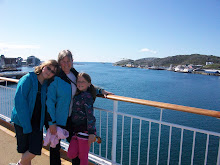
Poor Charley, all alone in California.........

That's what YOU think! Think again after this shot!
Charley and many moms from Noddin Elementary School - at the Spring Fiesta!
Start making room, ladies. I'll be back 7/2!

 My mom, 85, on a walk with the kick sled. Gorgeous weather - view straight south.
 Our last adventure was the Kon-Tiki Museum on Bygdøy. Thor Heyerdahl was a Norwegian explorer. He lived from 1914 to 2002. He was an archeologist, scientist and ethnographer. His first adventure was to live with his wife on the island Fatu Hiva in Polynesia from 1937-38. Their intention was not to return but did so after one year because of sickness and harsh living conditions.
 This is the Kon-Tiki raft. It is made from Balsa wood and other native materials. From Polynesia Thor went to BC and these two expeditions gave Thor information that suggested people came to Polynesia from South American and not Asia as people had believed. He set out in 1947 and followed the currents. After 101 days he landed where he wanted and proved scientist who didn't believe in his theory wrong. He wrote a book about the expedition and it became a documentary for which won an Oscar in 1951.
 After the successful Kon-Tiki expedition, many scientists were not convinced. Thor went to Galapagos and Easter Island for further research and archeological excavations and found evidence of settlements by Inca people. Scientists said people had to be critical to these findings, and in the 1990s it was finally proved by DNA that Polynesians had more similarities with Southeast Asian people than people from South America. This raft is the Ra II from 1970. Thor wanted to prove that there were connections between the people from South America and the people from Africa and the Middle East. Ra I dissolved because of a construction error, but Ra II made it from Marocco to Barbados in 57 days. One big difference between the expedition in 1947 and this one in 1970 was the amount of pollution and trash the crew found in the ocean. At the museum we saw a lump of oil about 16" in diameter. Pretty scary.
 Last day in Oslo and here is the Hotel we stayed at, SAS Scandinavia. It is located very close to the Royal Castle. Our room was in the 15th floor. On the 21st floor was a bar with great views over Oslo.
 This is the Oseberg Viking Ship. It was found in 1904 in the county of Vestfold, south of Oslo. Archeologists have dated the ship from about year 820. It was used to bury two prominent viking women in 834. It was buried underneath about 20 ft of grass peat and therefore very well preserved. When found in 1904, the grass peat cover had sunken down to only about 6 ft.
 This is the Godstad Viking Ship. It was found in 1880 in the city of Sandefjord, also south of Oslo. The ship was built in about year 900. Again, the ship was buried in a ground that preserved it very well, in blue clay. They found the remains of a 40 years old man in this ship.
 The dead were buried with many items for 'survival' in the afterlife. The valuables were robbed early on, probably already in the Viking times. Here are some items found. Combs (above).

 This is a coffin found in one of the burial mounds. When the archeologists first found the remains, they to tests and then buried it all again. Later, they discovered that there was lots of water in the area, dug the coffins out and found that some of the bones had been damaged. They decided not to bury the remains again. You can now see it at the museum.
 These are the remains after the 40 year old man found in the Gokstad Ship.
 Outside Oslo City Hall. The clock on the wall is a 16 ft in diameter astronomical clock. See Oslo City Hall on Wikipedia for a great close up of it. It consists of 2 dials; the outer with Roman numerals and the inner with Arabian number 1-12. It has four hands: time, dragon, sun and moon. The astrological sign dial moves and it takes 23 hours, 56 min and 4 sec (called the star day) to move around one time. The 'sun' hand takes 24 hours. In a year, the sun hand will be caught up by the astrological sign dial one after the other.
 This is inside the big hall at the Oslo City Hall. This is the very place where the Nobel's Peace Prize is given out on the 10th of December every year to the elected recipient.
 The art in the City Hall is wonderful. In 1937 a competition was opened for artists to submit their works. Eight painters and seventeen sculptors were hired to decorated this wonderful building. The City Hall was opened in 1950.
 After all this history and fabulous art, we met an old friend from Kristiansand for lunch at 'Aker Brygge'. This area has fashionable apartments, lots of shopping and wonderful restaurants. We had Italian with Terje. From Aker Brygge you can take a passenger boat to various places in the Oslo Fjord. The ferries in the inner harbor is cancelled in the winter time due to ice on the water. People have to take the bus instead.
 Right outside the park there is a statue of Sonja Henie. She was a famous Norwegian figure skater and actress. During the 1920s and 1930s she won many, many Olympic and Gold Medals She also has a star on Hollywood Walk of Fame! See Wikipedia for lots more information about her.
 We are just entering the Vigeland Park. It is the world's largest sculpture park with sculptures made by one single artist. There are more than 200 sculptures in the park, made by Gustav Vigeland.
 This little statue is called 'Sinnataggen' (Little Angry Boy) and is the most photographed and famous Norwegian statue. There are lots of cool pictures of it if you google 'sinnataggen'.
 'Monolitten' (The Monolith) was finished in 1943. It is 17 meters (more than 55 feet) tall and has 121 figures in it. Most of the statues in the park is made of granite. Monolitten is cut from one large piece of granite. Some believe the column is to be understood as man's resurrection, longing and yearning for the spiritual and divine.
 Around the plateau where the Monolith is situated, there are 35 figures which shows the cycle of life. This is the 'youngest' sculpture.
 The life of Edvard Munch was very depressing. Many people that were close to him died in a young age. He painted many very famous paintings; The Scream, Madonna and many, many more. We saw many of them, except the two mentioned. They will be on display starting coming summer.
 This is 'Vampire'. Veronica thought the viewing was interesting. It made Barbara sad to see all the dark and sad paintings. I am sure she'll understand it more when she grows older. Several school classes were touring the museum when we were there (one Danish and one Spanish).
 This is 'The Sun' painted by Edvard Munch. It usually hangs in the big hall at the University of Oslo, but that part of the Univ. is being restored at the moment, that's why this is kept at the Munch Museum. Parts of this room contained works by Munch being restored. Pretty cool to watch. See www.munch.museum.no for much more information on the painter and his works.
 This is where the Storting gathers for meetings. You have to sign up for a tour ahead of time, and we ended up with a private tour. Nobody else was signed up.
 The painting above the President of the Stortinget's seat is from when the first Norwegian Constitution was written in 1814. The Norwegian Constitution is the second one written down in history - after the US Constitution. The French and the British constitutions were is use for many, many years, but formally written down at a later time.
 In the Storting, the delegates can only vote no or yes; they can not refrain from voting. That's where you see the green and the red button. We were not allowed to sit on any of the chairs in Stortinget. The President of Stortinget has a direct view toward the Royal Castle, so that person and the King/Queen can look at each other..
 Today in Norway there are two smaller chambers that take care of certain cases. One is Lagtinget which consists of 42 of the Parliament's members. Lagtinget processes new law proposals in addition to being the Constitutional Court of the Realm, taking care of impeachment cases against members of parliament, ministers and supreme court judges.
 This is our private tour guide, Tonje. Lagtinget (together with another Chamber, Odelstinget) will be merged with the Stortinget in the fall of 2009. Look at Storting under Wikipedia for much, much more information about the Norwegian Goverment. Also, see Stortinget.no for even more information.
 The Lion is the symbol of Norwegian power (funny, huh? - Why not a moose or a polar beer?) and the hill in front of the Parliament is call 'The Lion's Hill".
 Veronica and Randi outside the Royal Castle. You can see the Royal Guardsmen on each side of the entrance. Norway has a King (Harald) and a Queen (Sonja). They have one son, Crown Prince Haakon, who is married and have 3 children. He has a sister, princess Martha Louise, who has 3 children as well. See Wikiepedia on the Royal Family of Norway for more information.
 This is on our way to the American Embassy to renew Veronica's US passport. Lots of snow, but very mild weather. While we were in Oslo, lots of snow disappeared.

 Two of the six Hereford cows on Altevik Farm. Hereford cattle were first imported to Norway in the 1950s. In the '70 the interest for this calm and self caring animal exploded in Norway. The Hereford take care of birth themselves and can live outside in a rough climate.
  Three calves were born this winter. It took a few days before the farmers were allowed by the cow to come close and take a look. It turned out that one calf wouldn't nurse and the cow had to be slaughtered because of utter problems. The calf is being kept inside at another farm for safe keeping and bottle feeding.
 After checking out the Herefords on the farm, the kids and I went to make snow caves. Making snow caves is an important thing to know for Norwegians who like to ski. Up in the mountains in Norway there are many cabins where people go hiking from one the the other in the summer time and ski the same in the winter. Similar to backpacking, but you bring your own sleeping bag and there are bunks, wood, some canned food (for emergency) and a shelter. Summers can even be harsh in the mountains. In the winter time the emergency supply of food could be used if you get caught in a winter storm. If you get caught between cabins, you need to dig a cave. Here are the 'official' Norwegian guidelines for what to think of before you go skiing in the mountains in the winter time:
 The girls made one cave together and it turned out pretty good.
 Lunch time after more than one hour of digging.
 Barbara made her own little one, too, with shelves and such.
 Everyone brought a couple little logs with them to make a fire. There were 6 small fire pits where we grilled hot dogs and bread dough. The students from 1st-10th grade are slit into 6 groups and have to help each other.
 Not every group succeeded in making a fire. Here is Veronica borrowing some fire to grill her hot dog.
 On the bus on the way home to Sandsøy again. 10 students and 2 teachers with the cross country skies and equipment filled the little 12 seater bus. Everyone was exhausted.
 Cross country skiing looking straight south. From the left: Sara (on winter break with her grandparents), Jonas, Sigrid and Barbara.